
Why 60% of Clicks Go to the Map Pack (And How to Get In It)
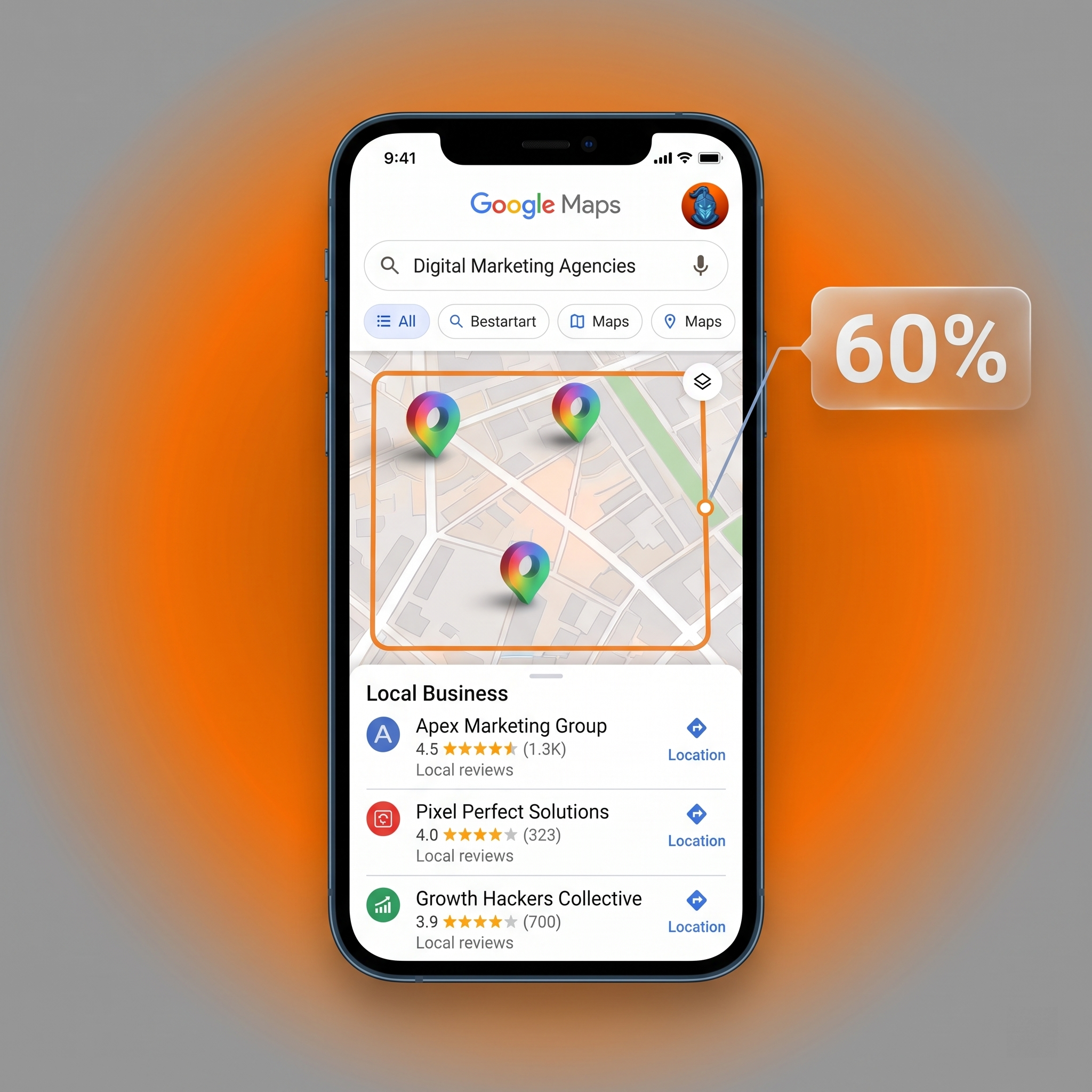
If you run an HVAC company, plumbing shop, or any home-service trade, you already know where your best leads come from: someone searches on their phone, taps a listing, and calls. What most owners do not realize is how concentrated that behavior is. On a typical local search results page, the Google Map Pack (those three business listings above the organic results) captures roughly 42% to 60% of all clicks, depending on the query and device. The #1 organic blue link below it often gets less than 15%.
That is not a rounding error. It is the difference between a full calendar and an empty one. And it explains why we built our entire Business Ranking Program around map visibility first, website second.
What the click data actually shows
Multiple eye-tracking and click-through studies over the past decade, from Moz, BrightLocal, and independent SERP analysts, have reached the same conclusion: when Google shows a map pack, users treat it as the answer. They do not scroll. They do not compare ten blue links. They pick from three.
The 60% figure you hear quoted most often comes from analyses of high-intent local queries like “emergency plumber near me” or “AC repair Tampa.” On desktop, the share is slightly lower because more screen space goes to ads and organic results. On mobile, where the majority of home-service searches happen, the map pack dominates even more aggressively, often taking 65% or more of clicks because it sits directly under the search bar.
Position 1 in the map pack is not marginally better than position 3. In competitive markets, the top listing can receive 2–3× the calls of the third slot.
Organic rankings still matter for informational searches and branded queries. But for “hire now” intent, the map pack is the game.
Why Google gives the map pack so much screen space
Google’s business model for local search is simple: connect a searcher with a relevant business as fast as possible. The map pack does that in one tap: call, directions, or website. No friction.
Three factors drive which businesses appear:
- Relevance: Does your Google Business Profile category, services, and content match what the person searched?
- Distance / proximity: Google weighs how close you are to the searcher’s location (or the location they specified). This is why geo-grid tracking matters: you might rank #1 downtown and #8 in the suburbs.
- Prominence: Reviews, citations, backlinks, and overall authority signals that tell Google you are a legitimate, trusted business.
Notice what is missing from that list: how pretty your website is. A mediocre site with a dominant GBP will beat a beautiful site with a neglected profile almost every time on map queries.
The real cost of map pack invisibility
We work with trade businesses that were spending $3,000–$8,000 per month on Google Ads because they could not crack the top three organically. The math is brutal: a $45 CPC on “roof repair” with a 5% conversion rate means roughly $900 per booked job from paid search alone.
Map pack rankings do not charge per click. Once you are in the top three, every tap is free. In markets we track, a single map pack position can generate 15–40 inbound calls per week for a well-optimized HVAC or plumbing company. At a conservative $400 average job value, that is $6,000–$16,000 in monthly revenue from one ranking slot.
That is why “we’re on page one” is the wrong goal. Page one of organic results is not the map pack. We have audited dozens of businesses ranking #1 organically who were invisible on the map, wondering why the phone stopped ringing.
How to get into the map pack: a practical framework
Getting into the top three is not luck. It is a stack of signals executed consistently over 60–120 days. Here is the sequence we use with every client:
1. Fix your GBP foundation first
Primary category must match your core service (not “Contractor” when you are an electrician). Service areas defined accurately. NAP (name, address, phone) identical everywhere on the web. Photos uploaded weekly. This alone separates you from 70% of competitors who set up their profile once and forget it.
2. Build review velocity, not just review count
Google weights recent reviews heavily. A business with 200 reviews and nothing in the last 90 days often loses to a competitor with 40 reviews and steady weekly inflow. We set up automated post-job review requests for every client.
3. Earn local citations that actually matter
Not 500 spam directories. Core data aggregators (Foursquare, Data Axle, Neustar Localeze) plus industry-specific listings: Angi, HomeAdvisor, BBB, your state contractor board. Consistent NAP across all of them.
4. Publish location-specific content
Service pages for each city or neighborhood you cover. Not duplicate content, but genuinely useful pages about local codes, common problems, and service areas. This reinforces relevance for proximity-based queries.
5. Track with geo-grids, not gut feel
Ranking #3 from your office does not mean you rank #3 three miles away. Geo-grid tools (like the report shown above) plot your position across dozens of points in your service area. That is how you know whether your optimization is working, or whether you are only visible in your own parking lot.
What does not move the needle
After managing 40+ trade business profiles, we can tell you what wastes time: keyword-stuffing your business name (“Joe’s Plumbing Tampa Best Plumber 24/7”; Google will suspend you), buying fake reviews, posting on 200 dead directories, and obsessing over website blog posts while your GBP sits half-finished.
Google is smarter than the tactics that worked in 2018. Focus on the signals it actually measures: relevance, proximity, and prominence, executed consistently.
The bottom line
The map pack is not one marketing channel among many. For home-service businesses, it is the channel. Roughly three out of every five local search clicks go there. If you are not in the top three, you are competing for scraps while your competitors answer the phone.
We work month to month with no contracts, because the results should be reason enough to stay. We have run this playbook enough times to know what it takes and what it moves.